Welcome to DECODED, a blog site for those interested in the period of history between the end of the Second World War and the final reunification of Berlin, Germany. This site is maintained by a Cold War history enthusiast, for other Cold War history enthusiasts and will be a source of information from both sides of the Cold War for history enthusiasts, political science fans, researchers, military history collectors and military veterans alike. Please visit the site regularly for updates. This site by no means is to represent or endorse any political agenda or ideology, information contained within is strictly used for the purpose of education and preservation of history for future generations. Thank you for visiting my blog, and welcome to the brink...

Thursday, August 15, 2013

Behind Enemy Lines Part I: The Berlin Brigade: America's Force in the Heart of East Germany


With the Allies declaring a victory in Europe with the surrender of the Nazis in May 1945, the stage was set for the post war occupation and rebuilding of Germany and Europe. World War II had proven devastating to the city of Berlin. Between 92,000 to 100,000 German soldiers were killed in the Battle of Berlin with some 125,000 civilian casualties inflicted on the population. In the initial days and weeks after the fall of the city and the capitulation of German forces, the Soviet Red Army enacted a dreadful period of reprisals and revenge against the German inhabitants of the city as they engaged in mass rapes against the female populous, pillaging and often murderering countless Germans. Soviet forces also went door to door arresting and imprisoning any German in uniform including non-military personnel such as firemen and railway workers. When military forces of the western Allies reached Berlin, they divided the city in a reflection of the division of Germany with each of the four victories allied nations maintaining a section of the city under its own jurisdiction. This was done in accordance with the Potsdam Agreement with the western nations occupying the western portion of the city and the Soviets occupying the eastern portion of the city. Under the Potsdam Agreement, the status of the city could not be changed without a quadripartite agreement. With the Allied controlled section lying so deep within the boundaries of Soviet controlled territory, the western Allies were guaranteed three air corridors for use flying into the city.

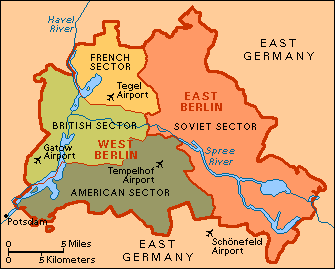
By 1948, relations between the western Allies and the Soviet Union began to rapidly deteriorate and came to a boiling point when the Soviet Union blockaded the city. The Soviet attempt to force the western Allies from Berlin was countered when the western Allies mounted a massive airborne relief effort by supplying the city from the air. The Berlin Airlift known accordingly as Operation Vittles and Operation Plainfare would prove largely successful and prove a psychological and physical defeat to the Soviets. By the end of 1949, the declaration of the establishment of the Federal Republic of Germany in the West and German Democratic Republic in the East largely ended the occupational status of Germany. With the establishment of West Germany and East Germany respectively, Berlin remained occupied as it's status could only be changed with a quadripartite agreement. West Berlin, which was the Allied controlled section of Berlin consisted of 12 boroughs. The French would occupy the northern sector of the city administering the boroughs of Reinickendorf and Wedding. The British would occupy the central portion of the city with the boroughs of Charlottenburg, Tiergarten, Wilmersdorf and Spandau falling under their jurisdiction. The Americans would occupy the southern portion of the city with the boroughs of Neukölln, Kreuzberg, Schöneberg, Steglitz, Tempelhof and Zehlendorf falling under their jurisdiction. The Soviets would occupy the twelve boroughs that made up East Berlin which included Friedrichshain, Hellersdorf, Hohenschönhausen, Köpenick, Lichtenberg, Marzahn, Mitte, Pankow, Prenzlauer Berg, Treptow and Weißensee.


The first American units would enter Berlin in July 1945, when elements of the 2nd Armored Division followed by elements of the 82nd Airborne Division and 78th Infantry Division entered the city to begin postwar occupational duties. These units were replaced by the 3rd Battalion, 16th Infantry of the 1st Infantry Division along with the 16th Constabulary Squadron (Separate) which would remain in place in the American sector of West Berlin from 1946 until 1950. These units were replaced following the activation of the 6th Infantry Regiment. Following restructing and reorganization of Army units in 1958, the 6th Infantry Regiment was replaced with two other units the 2nd Battle Group, 6th Infantry Regiment and 3rd Battle Group, 6th Infantry Regiment respectively. When Soviet forces and East German units began tearing up roads and setting up barricades the Berlin Brigade, the United States Army's permanently assigned military contingent to West Berlin was placed on high alert in anticipation of a coming Soviet attack. As tensions rose with the construction of the Berlin Wall beginning on 13 August 1961, the Brigade reflected President Kennedy and the United States's resolve to defend West Berlin from aggression and stood firm during a period of Soviet threats demanding the Allied withdrawal from Berlin. Tensions came to a headway on 27 October 1961, when American tanks and armored vehicles took up positions at Checkpoint Charlie and faced down Soviet armored vehicles. Eventually, the Soviets would relent and the tank standoff would end with no shots fired.

The Berlin Brigade had been established in response to the Crisis in Berlin. Infantry units of the brigade were organized along the lines of the pentomic structure. One formation designated as a "battle group" consisted of five line rifle companies, a combat support company, and a headquarters & headquarters company. The newly established Berlin Brigade would consist of the 2nd and 3rd Battalions of the 6th Infantry Regiment and the 4th Battalion of the 18th Infantry Regiment. The 4th Battalion, 18th Infantry was later redesignated as the 4th Battalion 6th Infantry Regiment. These battalions would later be reflagged to 4th, 5th and 6th Battalions of the 502nd Infantry Regiment. Additional units of the Berlin Brigade consisted of Battery C, 94th Field Artillery which would be replaced by Echo Battery, 320th Field Artillery. Company F of the 40th Armor, 42nd Engineer Company, 42nd Military Police Company (Customs), 287th Military Police Company (Separate), 43rd and 76th Chemical Detachments, 279th Station Hospital which was redesignated as US Army Hospital Berlin in 1976, 168th Medical Detachment (Veterinary Service), 592nd Signal Company, 298th Army Band. The 168th Medical Detachment and 298th Army Band would go on to share the distinction of being the longest serving United States Army units in Berlin.

The 4th Battalion, 502nd Infantry Regiment; 5th Battalion, 502nd Infantry Regiment and 6th Battalion, 502nd Infantry Regiments would be positioned in West Berlin until the end of the Cold War and leave Berlin in 1994. U.S. Army Berlin would maintain four large military installations known as McNair Barracks, Andrews Barracks, Roosevelt Barracks and Turner Barracks in the West Berlin boroughs of Zehlendorf and Steglitz. In the borough of Tempelhof, the Tempelhof Airport which had been used as a Nazi airport and was later occupied by the Soviets during the Battle or Berlin before being turned over to the 2nd Armored Division on 2 July 1945 was expanded and used as a military terminal for military personnel arriving in West Berlin. United States Air Force operations were typically transportation and intelligence gathering in nature. The United States Army also maintained a small contingent of helicopters at Tempelhof to augment the capabilities of the Berlin Brigade. The Berlin Brigade Headquarters was located at the Clay Headquarters Compound, named after the American Military Governor of the American Zone during the Berlin Airlift. The Clay Headquarters Compound also contained the headquarters of U.S. Army Berlin and the headquarters of U.S. Command Berlin. Together the three units were typically referred to as the Berlin Command. This would function as an independent command separate from United States Army Europe (USAREUR) which former commanded American forces in West Berlin.

American troops in West Berlin had standard ammenties authorized to all American units including a branch of the American Forces Network Europe better known as AFN which provided radio and television broadcasts for American servicemembers stationed in West Berlin. AFN Berlin maintained a facility near Saargemünder Straße and became immensely popular among Americans and Germans alike. During the Berlin Airlift, American pilots flying their Douglas C-47 Skytrain and C-54 Skymasters loaded with supplies bound for the airfield at Tempelhof, tuned their radios in to AFN Berlin due to the transmitting towers proximity to the airfield. AFN Berlin also proved immensely popular with listeners on the other side of the Iron Curtain as it maintained a way for people in communist nations to maintain contact with the West and it was not jammed by the Soviets such as was the case with Radio Free Europe. Soldiers assigned to the Berlin Brigade also had their own BX/PX facilities operated by the Army Air Force Exchange Service (AAFES) located at the Truman Plaza along with a Commissary, and several clubs and theaters. There was also an Army Post Office Facility located there along with a branch of the American Express bank, Stars & Stripes book store, a barber shop, florist, a branch of the Deutsche Bundespost along with the the Major Arthur D. Nicholson Memorial Library. For family members of servicemembers accommodations were located in the Düppel, Dahlem, and Lichterfelde boroughs along with educational facilities in the form of the Thomas A. Roberts Berlin American Elementary School (TAR) and Berlin-American High School (BAHS), were located in close proximity to the Truman Plaza shopping facilities.

 A close bond of friendship and appreciation was quickly forged between the residents of West Berlin and the American forces stationed in the city.


Soldiers of the Berlin Brigade had a unique duty of being assigned to pull guard duty in month long rotations at Spandau Prison located in the British Sector of the city. Beginning in 1947 through 1987 a period of forty years, elements of the Berlin Brigade took turns along with elements from the British Berlin Brigade, French Forces Françaises à Berlin and Soviet Forces in Berlin guarding prisoners at the prison. This mission would end when the last prisoner, Rudolf Hess the former  Deputy Führer of the Nazi Third Reich until his capture 12 May 1941 died in custody at Spandau on 17 August 1987 at the age of 93.

With the unit's position deep within the heart of communist East Germany, the unit often engaged in close cooperation with their Allied counterparts. American forces had a training facility in the West Berlin Grunewald borough which housed a shared training facility which was used by both the Americans and the British forces. The Americans designated their training facility here 'Doughboy City'. 

If they received authorization, soldiers could also travel into East Berlin often to see the Neue Wache, and the elite East Guard guard unit the Wachregiment Friedrich Engels as they stood guard around the SED communist parties important government facilities. Another common point of interest visited by American forces in East Berlin was the Soviet war memorial in Treptow Park. When visiting East Berlin, soldiers would travel in their Class A uniforms but were restricted from wearing nametags to prevent East German Stasi agents from gathering personal information regarding American personnel in the area.

With Berlin's unique legal status as an occupied territory left over from the days following the conclusion of the Second World War, members of the Berlin Brigade were authorized the Army of Occupation Medal with Germany clasp. The soldiers of the unit wore the standard patch of the United States Army Europe which maintained heraldic ties to the United States Seventh Army along with a special Berlin tab. The patch depicts a flaming sword and a arch of three colors representingthe three basic combat branches that make up a standing field army, these colors were blue for Infantry, red for Artillery, and yellow for Armor and Cavalry.

U.S. Army Berlin was commanded by a major general who was appointed the title of "Commandant; U.S. Commander Berlin and Commander, U.S. Army Berlin". In addition to this, a brigadier general would serve as the "Commander, Berlin Brigade (Infantry) along with receiving the titles "Deputy Commander, U.S. Army Berlin and Community Commander". There was also a specialized military liaison mission known as U.S. Military Liaison Mission (USMLM) positioned in West Berlin to serve as military intelligence services in the city and their support staff which often conducted their duties in Potsdam, East Germany. This was agreed to between the western Allies and the Soviets with each nation maintaining a small number of intelligence personnel in each others territory for the purposes of monitoring and improving relationships between the Soviet forces and Western occupation forces. The Mission teams were usually comprised of one officer accompanied by a non commissioned officer and a driver. The missions continued their operation throughout the Cold War period and ended in 1990 just prior to German reunification.


 Following the collapse of the Berlin Wall in 1989, the Berlin Brigade remained in West Berlin and elements of the Brigade would deploy in support of military operations in the Persian Gulf during Operation Desert Shield & Desert Storm. Elements of the unit would also participate in Operation Provide Comfort, a relief and protection mission for Iraqi Kurds following the cease of hostilities. Further elements of the unit would see service  as members of the United Nations Protectionary Forces designated UNPROFOR to Macedonia in July 1993. This mission was later renamed as Task Force Able Sentry. Others still would be deployed in July 1994, to Entebbe, Uganda as part of Joint Task Force Support Hope, to help prevent a humanitarian crisis resulting from a refugee situation as a result of the civil war in Rwanda.

With Germany reunified and the dissolution of the Soviet Union and the Warsaw Pact, a quadripartite agreement was reached and all non-German military forces were required to leave Berlin. The Berlin Brigade was officially deactivated by President Bill Clinton on 6 July 1994 having completed their mission of maintaining peace and freedom for over 49 years. The final review of Berlin Brigade forces was conducted when a ceremony took place in Berlin's Lichterfelde borough on the '4th of July Platz' located adjacent to McNair Barracks. The unit would go down in history as the American unit that existed deep within the heart of East Germany, and survive and maintain completely isolated and cut off from friendly forces for nearly half a century. 


United States Army Units in West Berlin

2nd Armored Division 1945
82nd Airborne Division 1945
  •       325th Glider Infantry Regiment
  •       504th Parachute Infantry Regiment
  •       505th Parachute Infantry Regiment

78th Infantry Division 1945-1946
  •       309th Infantry Regiment
  •       310th Infantry Regiment
  •       311th Infantry Regiment

11th Traffic Regulation Group (TRC), Detachment C, 1945-1947
483rd Air Service Group 1945-1948
US Military Liasion Mission, Potsdam (MLM) 1945-1990
7771st Document Center 1946-1994
Armed Forces Network Europe-Berlin 1945-1994
298th US Army Band 1945-1994
822nd MP -Co. 1945
388th MP -Co. 1945
296th MP -Co. 1945
18th MP Service Detachment 1947 - 1949
388th MP Service Platoon (Hospital) 1947 - 1949
62nd MP Highway patrol unit section 1949 - 1953
553rd Quartermaster Group 1945-1946
95th Quartermaster Battalion 1946
279th Field Station Hospital 1945-1976
US Army Hospital 1976-1994
3110th Signal Service Battalion 1945-1948
168th Medical Detachment 1947-1994
Berlin Military District 1945-1950
6th InfantryRegiment 1950-1958
759th Military Police Battalion 1945-1953
Horse Platoon 287th MP Company (Separate) 1945-1958
540th MP Co, Co. B, 2nd Platoon, Railway Guards 1949-1956
570th MP Co. Railway Guards 1957-1979
42nd Military Police Group 1973-1994
272nd MP-Co. (since 1947 combined US / West German police duty) 1953-1958
287th MP-Co. (combined US / West German police duty) 1953-1994
MP Helmstedt Detachment 1946-1961
Helmstedt Support Detachment 1961-1990
16th Cavalry Group 1945
16th Constabulary Squadron 1946-1950
7782nd Special Troops Battalion 1947-1994
39th Special Forces Det A 1956 - 1958
7781st Army unit Det A 1958 - 1984
Physical Security Element Berlin (PSSE-B) 1984 - 1994
S2 HQ Berlin District Command 1945 - 1949
Intelligence Office - COB 1950 - 1961
DCSI Berlin Command 1961 - 1994
979th CIC Detachment 1945-1950
66th CIC Detachment, 66th CIC Group 1950-1961
66th MI Group -Field Station- 1961-1969
766th MID, 66th MI Group 1969-1994
JAROC-B (from18th MI Batt. & 66th MI Group) 1950-1992
7829th Military Intelligence Platoon 1946-1949
7880th Military Intelligence Detachment 1949-1957
513th Int. Collection Group ( Berlin Station) 1948-1975
US Army Evalutation Unit 1962-1994
168th Medical Detachment (Veterinary Service) 1947-1994
Field Station Berlin 1949-1994
280th ASA Company  1957-1961
9539th Technical Service Unit (Signal Corps) 1954
22nd ASA Detachment 1955-1957
260th ASA Detachment 1957
78th Special Operations Unit 1961-1966
54th USASA Special Operations Command 1966-1967
7350th US Air Base Group 1948-1993
C Battery 94th Field Artillery 1963-1986
Company F, 40th Armor Reg.(Turner Tankers) 1958-1990
6th Battalion, 40th Armor Reg 1990-1992
503rd ENG Company 1949
7762th ENG Battalion 1946 - 1952
579th ENG Company 1946 - 1952
581st ENG Company 1946 - 1952
20th ENG, A Company 1958 - 1963
42nd Engineer Company 1963-1994
592nd Signal Company (Support) 1959-1979
Berlin Aviation Detachment 1962-1994
16th Inf./3rd Battalion (1st Inf. Div.) 1946-1950
US Army Europe / Tech. Intel. Center, Field Team No. 3 1962-1994
1st B.G. (8th Inf Div) & 4th Battalion / 18th Inf. 1961, 1963-1972
2nd Battle Group / 47th Inf.(4th Inf. Div.) 1962
1st Battle Group / 8th Inf.(4th Inf. Div.) 1962
2nd Battle Group / 12th Inf.(1st Inf. Div.) 1962-1963
1st Battle Group / 13th Inf.(1st Inf. Div.) 1963
1st B.G., 2nd & 3rd Battalions/19th Inf. (24th Inf. Div.) 1961, 1964-1965
1st & 2nd Battalions / 34th Inf.(24th Inf. Div.) 1963-65
1st Battle Group / 28th Inf.(-the Black Lions-from 1st Inf. Div.) 1963
2nd Battle Group / 26th Inf. (1st Inf. Div.) 1963
1st & 2nd Battalions / 21st Inf. (24th Inf. Div) 1964, 1966
2nd Battle Group, 6th Infantry 1958-1963
3rd Battle Group, 6th Infantry 1958-1963
2nd Battalion, 6th Infantry 1963-1984
3rd Battalion, 6th Infantry 1963-1984
4th Battalion, 6th Infantry 1972-1984
US-Army Berlin-Brigade (BBDE) 1961-1994
8001st US Army Reserve 1980-1994
43rd Chemical Detachment 1982-1994
E Battery 320th Field Artillery 1986-1994
4th Battalions 502nd Infantry Regiment (STRIKE) 1984-1990
5th / 6th Battalions 502nd Infantry Regiment (STRIKE) 1984-1994


United States Air Force Units in West Berlin

Transportation Units:

301st Troop Carrier Squadron (1945-1946)
47th Troop Carrier Squadron (1946-1947)
12th Troop Carrier Squadron (1947-1948)
53rd Troop Carrier Squadron (1948-1949)

Military Police Units:

1119th MP Company AVN, TCA, (1945-1948)
100th Complement Squadron, Army Air Force (1945-1947)
7352nd Air Police Squadron (1949)
7350th Air Police Squadron (1965-1993)
7350th Security Police Squadron (1965-1993)

Signal Units:

788th AAF Base Unit (1947-1948)
1946th Air Com. Squadron (1948-1953)
1946th AACS SQ/Com. Squadron (1954-1993)

Headquarters & Support & Units:

473rd Air Service Group (1945-1946)
715th Air Material Group (1945-1946)
891st Air Engineer Squadron (1945-1946)
808th Air Engineer Squadron (1946-1947)
632nd Air Material Squadron (1947)
HQ & Base Service Squadron (1947)
Tempelhof Base Unit (1947)
7351st Maintenance & Support Squadron (1948-1949)
7350th Air Base Group (1948-1993)
-Air Traffic Control Operations (AT)
-6912th Electronic Security Group (ESG)
-7025th Air Postal
Detachment 2, 435th Operations Group (1993-1994)
Detachment 1, 435th Air Wings (1993-1994)


Army Units assigned to U.S. Army Berlin / U.S. Command Berlin

Headquarters, Berlin Brigade

4th Battalion, 502nd Infantry
5th Battalion, 502nd Infantry
6th Battalion, 502nd Infantry
Combat Support Battalion
  • Headquarters & Service Company
  • A Company (Provisional)
  • C Battery 94th Artillery (redesignated E Bty, 320th FAR in 1986)
  • 43rd Chemical Detachment
  • 42nd Engineer Company (3)
  • E-320th Field Artillery Battery
  • Company "F", 40th Armor Regiment
  • Helmstedt Support Detachment

US Military Community Activity (USMCA)
  • 298th Army Band 
  • Signal Support Company
  • 287th Military Police Company

Aviation Detachment
6941st Guard Battalion
U.S. Army Field Station Berlin
U.S. Military Liaison Mission to the Commander-in-Chief, Group of Soviet Forces in Germany
United States Army Europe Technical Intelligence Center, Field Team #3 w/Duty Station Berlin
Joint Allied Refugee Operations Center (J-ROC)
Allied Control Authority
Allied Kommandatura
Berlin MEDDAC
Berlin DENTAC
168th Medical Detachment (Veterinary Services) 
Tempelhof Central Airport
766th MI Det, 66th MI Grp, Intel & Scrty
Naval Advisor
U.S. Army Special Security Det (Berlin)

U.S. Army EOD detachment


Wednesday, August 14, 2013

In Cold Blood along the Wall: The Killing of Peter Fechter


The Soviet Union and the communist satellite nations it subsequently developed within it's sphere of influence often went to extensive measures to make it appear that they operated and functioned to the best interests of its people. Outwardly, they embraced the ideals of freedom from oppression and equality amongst all collectively sharing everything and making great advancements in the achievements of mankind. Large emaculate festivals were frequently held and the ideas of labor highly regarded as essential to the success of the state. However, behind this facade of loving united fronts and value for human life was often a sinister truth. Desent and criticism of the state was an intolerable notion. Those who criticized the communist government or expressed ideals that were not compatible with those of the state risked imprisonment or certain death. Imagine living in a virtual prison state where the government dictated what you could do, when you could do it, how to do it and while declaring that you have 'rights' as a citizen of that nation, your rights are slim if any. Television, radio and all other media outlets are closely controlled by the state and to make matters worst, you can't even feel safe to express your true thoughts or feelings in your own home for fear you may be overheard and members of the secret police may show up in the middle of the night to arrest you. Wouldn't you begin thinking of ways to escape? Many would attempt to flee their prison nation; some would succeed and others would not.

On 13 August 1961, the East German government deployed soldiers of the Nationale Volksarmee and teams of construction workers to positions along the border of Allied controlled West Berlin and construction began on the Berlin Wall. The first concrete blocks would be put into place on 17 August 1961. With the Wall now turning West Berlin into an exclave deep in the heart of East Germany, it became much harder for persons wishing to leave the German Democratic Republic from doing so. No one could leave the communist nation without expressed permission from the government and all attempts to do so without authorization were met with armed resistance ordered to shoot anyone trying to leave without permission. The Schießbefehl or 'Shooting Order' became official policy on 22 August 1961, and the first person to be gunned down attempting to escape the repressive regime of East Germany would be twenty four year old Günter Litfin, a tailor who while attempting to escape by swimming across the Spree Canal was shot and mortally wounded by officers of the East German Transportpolizei. Litfin, would be the second confirmed casualty tied to the Berlin Wall, but he would be the first to die by being shot. Sadly, he would not be the last. After a tumultuous several months early on, life with the Wall began to normalize however escape attempts still became common place.

By the onset of 1962, the Wall and the defensive network that were associated with it had been vastly improved creating new challenges for those that wished to escape. By August of 1962, one young East German named Peter Fechter had like so many others decided that enough was enough and now he would take on the risks associated with crossing the Berlin Wall to seek better opportunities in West Germany. Peter Fechtner was 18 years old when he decided he would defect along with his close friend Helmut Kulbeik. The two young men developed a daring plan to first hide in a carpenter's workshop located close to the section of the Wall on Zimmerstrasse. They would then watch the Grenztruppen guards closely and after it was clear to do so, they would jump from a window over the initial barricade into the area known as the "death-strip", a strip of cleared area running between the main Wall and a parallel fence which was heavily patrolled by border guards and sentry dogs. Upon entry into the death strip they would attempt to run across it and climb over the 6.5 foot Wall which was topped with barbed wire and then fall into the safety of the Kreuzberg district of West Berlin not far from Checkpoint Charlie.


The date of execution of their plan would come on 17 August 1962. Initially everything went as planned, they hid in the carpentry workshop and dropped into the death strip sprinting across and reaching for the Wall itself. As they began to climb the concrete wall section, they were spotted by members of the East German Grenztruppen who began firing their weapons at the would be defectors. Fechter's friend Helmut Kulbeik managed to get over the wall, but Fechter still clinging on to the wall trying to pull himself up and over was struck in the pelvis by rounds from the East German rifles. On the West German side of the Wall, a large group of onlookers had gathered to watch the escape attempt and the wounding of Fechter was witnessed by hundreds of Western onlookers. Wounded, Fechter could not maintain his strength and fell back into the death strip on the Eastern side of the Wall but remained in plain sight of the horrified Westerners. Several people in the gathering crowd turned out to be western journalists who now had witnessed first handed how East Germany dealt with people it deemed as traitors.

Fechter lay in the death strip screaming for help, screaming in pain but his cries went unnheeded. The East German government issued orders not to provide medical assistance for persons wounded in escape attempts and to add to this, East German border troops were afraid of being fired at by West German policemen stemming from an incident several days earlier. Furthermore western citizens did not react to Fechter's cries for help out of fear of being fired upon by the East German border troops. All in all Fechter had no real chance of survival, the impact of the high caliber rifle round into his right hip had caused severe internal injuries and he was losing blood rapidly. He would lay in the death strip for one hour before he succumbed to his injury, bleeding to death before a shocked western audience. When his cries ceased, it was only an hour later still, that East German border troops and policemen finally entered the death strip and retrieved his body.


The subsequent stories regarding the shooting of Fechter enraged the West German government and brought a wave of negative publicity to the East German regime. Hundreds of people in West Berlin organized demonstrations against the German Democratic Republic, shouting "Mörder!" or Murderers! at the East German Grenztruppen border guards. As a direct result of the Fechter murder and the following backlash, the East German government revised its orders to the border troops with revised protocol including more direct restrictions on the use of shooting in public settings particularly in front of a crowd of onlookers. Furthermore, the government authorized the granting of medical assistance to any would be escapee who was wounded in an attempt to flee from East Germany. Although Fechter would not live to see the fall of the Berlin Wall in 1989, in the years leading up to the end of the division of Germany he became a martyr in the struggle for German reunification. Memorials would be erected in his honor and those of others murdered trying to escape. Numerous tributes would be dedicated in his memory and his death would became the subject of many films, documentaries and books. Although he would not be the last person to die trying to escape over the Berlin Wall, he was instrumental in reforming policy in dealing with would be escapees. 


Tuesday, August 13, 2013

Imprisoning a Nation: The Birth and Death of the Berlin Wall


Following the end of the Second World War and the division of post war Germany among the victorious allies, the areas of occupation gradually began to adopt the ideological policies of their governing authorities. Josef Stalin, premier of the Soviet Union revealed his intention to communist allies in eastern Germany by 1946 that he planned to undermine western efforts to democratize Germany first by undermining British authority in it's zone and he expected the Americans to withdraw from its zone of occupation within a span of two years which would lead the way for Soviet invasion and the domination of Germany under a purely communist regime. With the war over and a semblance of normalcy beginning to return to the land, the majority of the populations living in the newly acquired areas of the Eastern Bloc aspired for national independence and wanted the Soviets to leave their homelands. This was not to be. The East German government was closely modeled on it's Soviet overseer  complete with an extensive network of often redundant organizations and security apparatuses installed to suppress the population to which it claimed to represent. Property and industry were largely nationalized in the East German zone along the lines of the Soviet collectivization ideology under communism. In 1950, the number of East Germans leaving for the West numbered 187,000. This number rose to 165,000 in 1951, 182,000 in 1952 and 331,000 in 1953. Fears of further Sovietization of eastern Germany led to a sharp spike in the number of people fleeing West, this was reflected by the fact that in the first six months of 1953, some 226,000 Germans packed up and moved West.

The East German security services and Soviet secret police began clamping down on the daily activities of those under the Soviet sphere of influence in Germany. If statements or decisions deviated from the prescribed party line, reprimands and in the case of persons beyond the scope of public attention, punishment would ensue, including not only detainment and imprisonment but also the systematic use of torture and even death could be the end result. The mandatory indoctrination into the Marxist-Leninist philosophy sent many citizens particularly the educated class of teachers and students in the Soviet Zone of Occupation fleeing for freedom from persecution in the western zones. Having largely grown distrustful of the Soviets following the period of brutal reprisals and vengeance as Soviet forces occupied eastern Germany in the immediate aftermath of the war, any chance to escape to the West was a welcomed change. West Germany soon became known for it's new Soziale Marktwirtschaft 'Social Market Economy' which embraced capitalist ideas which soon led to a much enjoyed twenty year period of prosperity known as the Wirtschaftswunder or Economic Miracle. As the situation improved in post war West Germany, the standard of living and economic situation also improved and many East Germans began seeking ways to reach the western zones to better themselves and further provide for their families.

With the German people beginning to flock in mass towards the West from the East, the Soviet authorities in eastern Germany soon installed a system of immigration restrictions and began closely monitoring the activities and movement of the population under its jurisdiction. A special pass was required to visit East Berlin from the West officially to prevent the movement of 'Western Agents' within East Germany's borders. Stalin advised the East Germans to begin building up their defensive network along the border area with West Germany. By 1952, this demarcation line officially known as the Inner German Border which separated the Federal Republic of Germany in the West, from the German Democratic Republic in the East was closed and barbed wire fences erected in an effort to restrict the movement between the two parts of the nation. The Berlin Airlift only a few years earlier had embarrassed the Soviets to no end and now they seeked other ways to spite the western Allied. In contrast to the Inner German Border Zone, in divided Berlin the border zone continued to remain open, in effect a severe miscalculation by the Soviets and the East Germans. Berlin soon became a hotbed for defection activities as many East German cities found it to be the only route of escape into the West. As a result of this, and West Berlin's status as a free city deep in the heart of East Germany, it became the epicenter for rising tensions between the United States and the Soviet Union.


In 1955, the Soviets turned authority over civilian movement in Berlin over to the East German government. This transfer of power was not recognized by allied powers in the West who saw East Berlin as an illegitimate entity. With the increased movement of people westward, the new East German state move to restrict all travel to the West in 1956.  With the Inner German Border closed, East Germany's government attempted to further restrict movement into West Berlin by introducing a new passport system in 1957. Those caught trying to leave were heavily fined, however with no physical barriers and a subway system running between the two halves of the city these measures were for the most part ineffective in preventing those persons from leaving the country. By 1961, nearly 20% of East Germany's population or roughly 3.5 million East Germans had escaped to freedom in the West. The majority of these immigrants fleeing from the Communist system were young, well educated individuals who sought the freedoms of democracy embraced in the West. This mass exodus from the Soviet sphere of influence was quickly referred to by the communist regime as a 'brain drain'. Most immigrants officially stated their reasons for leaving were political more than materialistic.

By 1960, the 'Brain Drain' effect had left the German Democratic Republic with only roughly 61% of its population of working age, a steep drop compared to 70.5% before the Second World War. The loss of labor force was heaviest among professional services including engineers, technicians, physicians, teachers, lawyers and skilled laborers. The direct cost of manpower losses to East Germany (and the corresponding gain to the West) was estimated to have been anywhere between $7 billion to $9 billion, with East German SED communist leader Walter Ulbricht demanding that West Germany pay him $17 billion in compensation, including reparations as well as manpower losses. In addition to this, the draining of East Germany's youth population potentially cost the East German state over 22.5 billion marks in lost educational investment. The brain drain of professionals had become so damaging to the political credibility of the SED and economic viability of the German Democratic Republic that the re-securing of the German communist frontier was imperative lest the nation collapse.


Initially denying his intentions, East German communist party leader Walter Ulbricht along with support from the new Soviet leader Nikita Khrushchev soon signed the initiative to close the borders and erect a wall around West Berlin. Khrushchev would succeed Josef Stalin following his sudden death in 1953. At exactly midnight on 13 August 1961, East German police and military units effectively sealed the border in Berlin and a force of construction units and laborers began the tedious task of tearing up the roads adjacent to the border making them impassable to vehicles and positioning obstacles along the border itself. Barbed wire fences and entanglements were installed surrounding the entire length of West Berlin effectively sealing it off from East Germany. These barriers were precisely positioned within East German territory to ensure it did not violate West Berlin's territorial sanctity at any time. On 17 August 1961, the first cement bricks were put into place to begin the construction of the physical barrier, the Berlin Wall itself. Soldiers of the Landstreitkräfte and members of the Kampfgruppen 'Combat Groups of the Working Class' were positioned along lengths of the border with orders to shoot anyone attempting to flee East Germany for West Berlin. In addition to the manpower, an assortment of chained fences, walls, minefields and other obstacles were installed along the length of East Germany's western border with West Germany. A huge no man's land was cleared to provide a clear line of fire for Grenztruppen and Volkspolizei units attempting to stop defecting refugees from reaching their intended destination.

In an instant almost overnight, entire families of Germans were separated and Republikflucht or Desertion of the Republic as it was declared was made a capital offense by the East German government. Hundreds were shot and killed trying to cross the new Berlin Wall, and estimates show that nearly 75,000 were caught and imprisoned for trying to escape into West Berlin between the construction of the Wall in 1961 and 1989. Officially East German government authorities declared the Wall to be an Antifaschistischer Schutzwall or Anti-Fascist Protective Rampart intended to dissuade aggressive or non productive influences of the West from corrupting the progressive ways of the Workers Paradise.The Wall was essentially a public relations disaster for the SED communist officials attempting to improve their image with the people of East Germany and the World, particularly in the West. There were nine authorized crossing points along the border where Berlin citizens could cross into West Berlin and these were closely monitored by Grenztruppen forces and agents of the Stasi. Several subsequent border crossing points were established for West Germany to use for crossing into East Germany and four autobahns were designated for this purpose, linking West Berlin to West Germany by road.

The East German government did not allow apartments along the length of the Wall to be occupied and thus windows and doors of many facilities were bricked up or barricaded. In many cases the only open windows and non barricaded areas were above the third or fourth floors in an attempt to guarantee any defection attempt involving leaping from these heights would ensure serious injury if not death. With the Wall effectively in place, the SED government issued what was known as the Schießbefehl or 'shooting orders' to members of the border guards when dealing with potential defectors. Under this order, the Guards were to first aim there weapons and order the defector to halt. If the person did not stop, a warning shot was fired and if this still did not prevent the person from stopping their activities, the Guard was to open fire with the intent on killing the fleeing person. The official stance from East German authorities was intended to encourage the Guards to shoot escapees stating, "Do not hesitate to use your firearm, not even when the border is breached in the company of women and children, which is a tactic the traitors have often used".

The most famous of the land based crossing points that linked West Germany to West Berlin, through East German territory was the Berlin-Helmstedt autobahn, which entered East German territory between the towns of Helmstedt and Marienborn. This crossing point into East Germany was designated as Checkpoint Alpha, and entered West Berlin at Dreilinden in southwestern Berlin. This entry point into West Berlin would be designated as Checkpoint Bravo for Allied forces. Access to West Berlin was also possible by railway in the four of four officially sanctioned routes and by boat for commercial shipping via canals and rivers. Westerners who were not German could cross the border at the Friedrichstraße station in East Berlin and at Checkpoint Charlie. Not even the areas underneath the city escaped division. Berlin's sewer system was even barricaded to prevent defection, and with the Wall erected, Berlin's complex public transit networks, the S-Bahn and U-Bahn, both a system of underground high speed railways were divided along with the city above it. Some lines were cut in half and as a result many of the subway stations were shut down. Three western lines traveled through brief sections of East Berlin. The trains would pass through eastern stations unrestricted as they were forbidden to stop at these stations which were known as Geisterbahnhöfe, or ghost stations. Both the eastern and western networks converged at Friedrichstraße, which became a major crossing point for those who had been granted permission to cross from East to West.


Escape attempts dropped drastically with the construction of the Berlin Wall, however defections did still occur with one of the most famous being the defection of a young East German soldier named Conrad Schumann during the initial construction of the Berlin Wall. With merely a low barbed wire entanglement separating Berlin, West German citizens shouted to him, "Komme über!" or "Come over!". A West German police car pulled up to wait for him. With the motivation to defect Schumann jumped over the barbed wire fence and was promptly driven away from the scene by the West Berlin police. West German photographer Peter Leibing photographed Schumann's escape, and this picture has since become an iconic image of the Cold War. See the article on Conrad Schumann here.

Other escapes in the initial days of the constructing of the Wall simply involved people jumping the simple barbed wire fortifications or leaping out of apartment windows along the line, but these ended as the Wall was fortified and reinforced.

The first death to result from an attempt to defect into West Berlin occurred when a young woman named Ida Siekmann jumped from her third floor apartment window at 48 Bernauerstraße on 22 August 1961. The first shooting death would occur two days later on 24 August 1961, when a young twenty four year old tailor named Günter Litfin was shot by members of the Grenztruppen as he attempted to defect by swimming across the Spree Canal to West Germany. 24 August was also the day that the Schießbefehl officially went into effect. East German citizens still managed to best the East German fortifications and successfully defect by a variety of methods. These measures included not only digging long tunnels under the wall but also waiting for favorable winds and taking a hot air balloon, sliding along aerial wires, flying ultralight aircraft across the Wall, and in one instance, simply driving a sports car at full speed through the basic, initial fortifications. As a response to the motor vehicle traffic as a measures of defection, a metal beam was em-placed at checkpoints to further prevent this kind of defection. The people countered this by having up to four people, usually with two in the front seats and possibly two in the trunk of the vehicle drove under the bar in a sports car that had been specially modified to allow the roof and windscreen to sheer away when it made contact with the metal obstruction. The escapees would lay flat and keep driving forward until they were clear of East German territory and reached the safety of West Germany. The East Germans responded to this by constructing zig-zagging roads leading up to checkpoints. The sewer system although with it's own network of barricades served as a means of escape. Some people escaped through the sewers, and in a number of cases with assistance from a prominent student group from the western side of the city.

Another highly successful escape occurred in April 1963 on the eve of the annual May Day celebrations in East Germany when a nineteen year old civilian employee of the Nationale Volksarmee named  Wolfgang Engels penetrated the Wall and escaped into the West. Engels having won the confidence of Soviet soldiers earlier and got them to demonstrate the operation of their vehicle, stole a Soviet armored personnel carrier from a nearby base where he was deployed and drove it right into the Wall. The vehicle did not fully penetrate the Wall and Engels was forced to exit the vehicle and became entangled in barbed wire. As a result of what was occurring he was shot at and hit twice, which seriously wounded him. A West German policeman intervened on Engel's behalf, firing his weapon at the East German border guards and removed Engels from the vehicle, which too was entangled in the barbed wire. He was removed from the scene to the safety of a West German bar and he would recover from his wounds in a West German hospital.

On another occasion, Thomas Krüger a member of the East German youth organization the  Gesellschaft für Sport und Technik, made an airborne escape attempt and landed a  Zlin Z 42M light aircraft at the British military airfield at RAF Gatow in West Berlin. His aircraft was returned to East Germany, but not without tongue in cheek slogans sprawled across it from Royal Air Force servicemen such as "Wish you were here" and "Come back soon".

Many potential escapees were wounded attempting to flee into the West and if they were within the 'death strip' area no matter their proximity to the western side, Westerners could not intervene to assist the wounded out of fear of provoking attack from East German military or security forces. East German Grenztruppen border guards notoriously left wounded would be defectors to bleed to death in this area such was the most infamous case regarding eighteen year old Peter Fechter on 17 August 1962. The negative attention garnered by the East German government as a result of the Fechter incident, prompted East German authorities to authorize and enforce stricter rules for the discharging of weapons in public view. Following the Fechtner incident, the policy of leaving wounded to die was reversed and medical care was to be offered to the wounded individual. The last shooting death along the Wall occurred in 1989 when twenty year old Christopher Gueffroy was hit in the chest by ten rounds from AK-47 assault rifles fired by Grenztruppen soldiers and left to die in the border strip.  The widespread violence associated with the construction of the Wall led many in the East to develop feelings of desperation and feeling oppressed by the ruling regime.

Throughout the duration of its existence, it is estimated that 5,000 people successfully escaped through the Berlin Wall into West Germany. Almost 200 were confirmed killed attempting to escape and another 75,000 were wounded attempting to defect.


The beginning of the end of the Berlin Wall came on 12 June 1987, when American President Ronald Reagan visited West Berlin to commemorate the 750th anniversary of the city of Berlin. In a speech at the Brandenburg Gate, he openly challenged Soviet leader and General Secretary of the Communist Party, Mikhail Gorbachev. In a speech which would become famous, Reagan demanded that he open the Brandenburg Gate and tear down the Berlin Wall as a symbol of granting increasing freedom in the Eastern Bloc.

On 19 August 1989, the People's Republic of Hungary began dismantling its border defenses along its border with the Republic of Austria and in the following month some 13,000 East Germans traveled first to Hungary as tourists to defect to the West through Austria. With this in effect, the Hungarians began refusing East Germans access to the border areas and sent them to Budapest to await repatriation to the German Democratic Republic. Rather than go back to the oppression of East German, these people stormed the West German embassy seeking asylum in West Germany. When knowledge of this became widespread, the East German authorities forbid further travel to Hungary by its citizens and a small incident broke out in neighboring Czechoslovakia. Protests soon followed all across East Germany which led to the widespread Peaceful Revolution of 1989.

The longtime leader of the German Democratic Republic and SED Communist Party, Erich Honecker, effectively resigned on 18 October 1989 and was replaced by Egon Krenz a few days later. Honecker had announced in January, that the wall would stand for 50 or 100 more years if the conditions that had caused its construction did not change. The Peaceful Revolution would peak in November when half a million people gathered at the Alexanderplatz demonstration, to advocate change in East Germany. The amount of refugees continued to increase as they fled East Germany through Czechoslovakia and then into Hungary or through the West German embassy in Prague. On 9 November 1989, Günter Schabowski, the party boss in East Berlin and the spokesman for the SED Politburo, had the task of announcing new relaxed travel restrictions allowing refugees to exit directly through the authorized border crossing points between East Germany and West Germany, including those in West Berlin. On the same day, the ministerial administration modified the proposal to include private travel. The new regulations were to take effect the next day 10 November 1989.

He read the note authorizing the changes out loud at the end of a conference and one of the reporters, ANSA's Riccardo Ehrman, asked when the regulations would take effect. After a few seconds'  pausing with hesitation, Schabowski having been given no further instructions on how to handle the situation assumed it would be the same day based on the wording of the note and replied, "As far as I know effective immediately, without delay". After further questions from journalists he confirmed that the regulations included the border crossings towards West Berlin, which he had not mentioned until then. With no one wanting to take personal responsibility for issuing orders to use force to subdue the growing crowds, Grenztruppen personnel were soon overwhelmed by the mass of East German citizens and at 10:45 pm on 9 November 1989, the border checkpoints were opened and people flooded in celebration into both parts of the city. Not everyone in East Germany or other Communist nations were enthused about the collapse of communism or the impending reunification of Germany. One prominent figure to oppose the reunification was British Prime Minister Margaret Thatcher, whom in September 1989 pleaded with Soviet leader Mikhail Gorbachev to do what he could to prevent the fall of the Wall. Another person who opposed the reunification of Germany was French President François Mitterrand.


 The Wall would begin to crumble almost immediately as "Mauerspechte" or wall woodpeckers began using sledgehammers, hammers and chisels to chip off pieces of the Wall as souvenirs, often destroying lengthy parts of it in the process and creating several unofficial border crossings. A week following the 9 November announcements ten new border checkpoints were announced. These new locations included Potsdamer Platz, Glienicker Brücke and Bernauer Straße with the historically significant Brandenburg Gate being officially opened on 22 December 1989. After subsequent policies and new restrictions, for a period of time East Germans could travel more freely than their West German counterparts. On 13 June 1990, the East German government began the official dismantling of the Wall at Bernauer Straße. On 1 July, the East German government officially adopted the West German Deutsche Mark as its standard currency and all border control checkpoints ceased to be manned and operated. The inter-German border had however become meaningless for some time before that point. The dismantling continued to be carried out by Nationale Volksarmee units and later by Bundeswehr units after the NVA was absorbed into the Bundeswehr.  The removal of the border fortifications and obstacles lasted until November 1991. Only a few small sections of the Wall and its watchtowers were left to remain standing as memorials to the division of Germany.


The fall of the Berlin Wall was the first step towards complete German reunification, which was concluded on 3 October 1990 when for the first time since 1949, East and West ceased to exist and Germany became whole once again.

The Berlin Wall would run the entire length around West Berlin, effectively 96 miles. The length of the border between West Berlin and East Germany was 69.5 miles, with the length of the border between West and East Berlin being 26.8 miles. 23 miles of the border would run through residential areas and the concreted wall segments would reach a height of 12 feet tall. The length of the concrete segments of the Wall were 66 miles with 41.3 miles of the border being made up of wire mesh fencing. There were 65.6 miles of anti-vehicle trenches and 79.2 miles of signal and or contact fences strung along this area. There were 302 watch towers constructed around West Berlin and 20 bunkers placed in positions around the City.


Monday, August 12, 2013

Penetrating the Blockade: How Operation Vittles sustained an encircled City


The year was 1945, Berlin much like the rest of Germany lay in a state of ruin. Her streets and buildings were pockmarked with the graffiti of war. Shell craters, smashed windows and twisted figures of stone, mortar and steel littered the streets stretching towards the sky like some grotesque carcass reaching to achieve a final grasp. Adolf Hitler, the leader of the defeated nation was dead, committing suicide to escape the western Allies held bent on bringing him and his legion of cronies to justice for the crimes they had committed over the span of some twelve years. The nation was in a state of dispair facing an uncertain future as foreign forces occupied the wartorn land. As per the Yalta and Potsdam Conferences earlier in the year, Germany was carved up into zones of occupation administered by military forces of the wartime Allies. These sectors encompasses areas associated to the current positions of the Allied armies at the time and in a minature reflection of this, Berlin would reflect the division of the nation. Berlin, a once great city  had suffered catastrophic damage. Once boasting a population of 4.6 million people before the Second World War, it was now reduced to nearly 2.8 million people with only the capacity to produce 2% of the food needed to support the population. The forces of the United States, United Kingdom and France were not permitted to enter the war ravaged city until nearly two months after Germany had capitulated, during which time the local populace suffered brutal reprisals at the hands of the conquering Soviet Red Army.

The western portion of the nation would see the British taking responsibility for most of the northern part of the country, the Americans taking responsibility for the southern part of the country and both turning over two small portions of their zones of occupation that barely contacted each other along the French border over to the forces of France. The eastern portion of the nation would go to the Soviets. One area of protest came with the status of Berlin, which put forces of the United States, United Kingdom and France some 100 miles inside the Soviet zone of occupation. The areas under Soviet control, produced much of the food that fed the nation and thus the regions under American and British control largely relied on food imports from the very beginning. With the United States, United Kingdom and France largely instilling the principles of democracy to their post war areas, the Soviet Military Administration forcibly unified the Kommunistische Partei Deutschlands 'Communist Party of Germany' and the Sozialdemokratische Partei Deutschlands 'Social Democratic Party of Germany' to form the Sozialistische Einheitspartei Deutschlands 'Socialist Unity Party of Germany' claiming that it would not occupy a Marxist-Leninist or Soviet stance on its body politics. Immediately after its formation, the SED Party called for the establishment of an anti-fascist, democratic regime in the form of a parliamentary democratic republic. Under this ruse, the Soviets suppressed all activities of non SED aligned political parties and expatriated many factories and equipment as well as their technicians, managers and skilled personnel to regions deep in the Soviet Union.


Soviet leader Josef Stalin made his true intentions clear before the smoke of the Battle of Berlin had even fully cleared, telling German communists that he planned to undermine the authority of the British in their zone of occupation and force the United States to withdraw within the span of two years and thus he would unify Germany as a single communist nations under Soviet control.

One of the loopholes in the agreements reached by the western Allies was that there had never been any formal agreements guaranteeing rail or road access to Berlin through Soviet occupied territory. The first signs of ensuing tensions began when the Soviets imposed a limitation on the amount of cargo that could enter its territory. The Soviets set the limitation at only ten trains per day by only one single rail line. Believing the Soviet limitations were temporary at most, the Allies shrugged it off and began proposing addition alternatives to the Soviet Union which were rejected by the Soviets. In a move to further put a squeeze on the Allies in Berlin, the Soviet Union enforced the utilization of only three air corridors into Berlin with access to Berlin being authorized only from Hamburg, Bückeburg and Frankfurt. As the situation between the former allies began to deteriorate, the Soviets halted the delivery of agricultural goods from their zone of occupation into Berlin. This was countered accordingly when the American Commander, General Lucius Clay halted shipments of dismantled industrial goods from western Germany to the Soviet Union.

Angered by the American action, the Soviets began a campaign to undermine the Allies by slandering the American mission in Germany and hinder the administrative work of all four zones of occupation inside Berlin. Having surviving harsh treatment, forced emigrations, severe political repression and a particularly rough winter of the 1945–1946 period, Germans in the Soviet zone of administration were growing extremely hostile to the Soviets and their plans. Local elections in 1946 resulted in a massive anti-communist protest vote across the city, especially in the Soviet sector of Berlin. Berlin's citizens overwhelmingly elected non-Communist members to its city council reflecting an overwhelming 86% majority. The clouds of trouble had begun building on the horizon.

In January 1948, the Soviets began stopping American and British trains bound for Berlin to confirm the identities of passengers onboard the trains, With the Marshall Plan being enforced across, western Europe the Soviets began orchaestrating a plan to force the Allies to align their interests along with the wishes of the Soviet Union through further regulating access to Berlin. To test the waters, on 25 March 1948, the Soviets issued an order that hindered the movement of traffic between the American, French and British zones of occupation and Berlin stating that no cargo could leave Berlin without the expressed approval of the Soviet Commander.Each truck or train would be searched by Soviet authorities before it would be allowed to leave the city. On 2 April 1948, General Clay halted the use of military trains and ordered that all cargo be flown in and out of the city by air. This venture would be known affectionately as the 'Little Air Lift'. On 10 April 1948, the Soviets eased their restrictions but continued to harass Allied traffic in and out of the city. The Soviets then began a campaign of violations of West Berlin's airspace with their own military aircraft which resulted in a deadly incident on 5 April 1948 when a Soviet Yakovlev Yak-3 fighter collided with a British European Airways Vickers VC.1 Viking transport near RAF Gatow resulting in the deaths of all aboard the colliding aircraft.

The final calm before the store occurred when on 9 April, the Soviets first demanded that American communication equipment in Soviet territory be withdrawn thus preventing the use of navigational beacons to designate air routes. This was followed by a Soviet declaration demanding barges from the west to obtain a special clearance before entering Soviet occupied areas. With the introduction of the new Deutsche Mark in the western part of the country, the Soviets stated that the only currency allowed into Berlin would be one that they issued in a move to keep Germany weakened and in a state of recession. By the time the Soviets began to introduce their own currency into Berlin, the western Allies had already transported 250,000,000 Deutsche Marks into the city and it quickly took over as the standard currency of all four sectors of the city. The introduction of the Deutsche Mark and the Marshall Plan which would bring upon an economic miracle to the nation was seen as a move to undermine Soviet intentions and Stalin interpreted this a provocation against him. He now wanted the Allies out of Berlin completely.

On 18 June 1948, the Deutsche Mark was announced as the new currency to be used in the allied zones of occupation. The Soviets responded by halting all passenger trains and traffic on the autobahns of Berlin. On 21 June, the Soviets refused entry to an American military supply train and sent it back to American territory in western Germany. On 22 June, the Soviets introduced their own new currency that it called the 'Ostmark' for use in it's zone of occupation as a method to undermine the integrity of the Deutsche Mark. Also on the 22nd of June a Soviet official sent a memorandum to the Americans, British and French in the city stating that both their forces and the population of Berlin would be subjected to economic and administrative sanctions that would lead to the circulation in Berlin of only the currency of the Soviet occupation zone. This was followed by a propaganda campaign in which the Soviets denounced the United Kingdom, United States and France by radio, newspaper and loudspeaker. With a large Soviet military exercise on the outskirts of the city, rumors began to circulate of an impending Soviet invasion and occupation. German communists added to this state of aggitation when they staged protests, riots and attacks against pro-West German leaders in Berlin.


The Berlin Blockade would begin on 24 June 1948, when the Soviet forces halted all communications on land and water between the western zones and Berlin. This was quickly followed by the halting of all rail and water traffic in and out of Berlin. The next day, the Soviets halted all supplies of food to the civilian population of western Berlin as well as cut the flow of electricity from power plants in eastern Berlin to the West. For the time being, road access to the city was still authorized but only after a fourteen mile detour to a ferry crossing. The official reasoning was that Soviet forces were conducting repairs to critical infrastructure. Traffic from the western zones of occupation bound for Berlin were blockaded and all arguments permitting to the occupation rights in western Berlin fell on deaf ears. Only Soviet good will towards the western Allies made access to Berlin possible, but with no formal agreement in place the Soviets could negotiate the terms of usage of transit routes in and out of its zone of authority any way that it wished.

West Berlin was now in a critical state. It had on hand only enough food for 36 days, and enough coal to last for only 45 days. Military forces in West Berlin numbered only a force of 8,973 Americans, 7,606 British and 6,100 French in contrast to a force of one and a half million Soviet troops in East Berlin and the Soviet zone of occupation which surrounded it. On 13 June 1948, General Clay sent a cable to Washington D.C. reaffirming his stance in West Berlin and declaring that their would be no withdrawal from Berlin. While, the Soviets celebrated their blockade of Berlin and anticipated the withdrawal of western forces from eastern Germany, General Clay called the Soviets bluff, believing that the Soviets would not intentionally initiate World War III, especially not having just barely recovered from World War II. With limited options at his disposal, Clay heard numerous proposals from Allied leaders including an aggressive response to the blocakde proposed by General Curtis LeMay, the Commander of United States Air Forces in Europe in which waves of Boeing B-29 Stratofortress strategic bombers and fighter escorts would engage Soviet airbases while ground troops in western Germany would attempt a breakthrough to reach encircled Berlin. This plan was ultimately rejected by Clay.

With time running, out Clay authorized the use of Berlin's airways to undermine the Soviet blockade. This was a move that the Soviets had not counted on. On 30 November 1945, the Allies had recieved in writing the approval for free access to Berlin via three twenty three mile wide air corridors. Further undermining the Soviet blockade, the usage of cargo aircraft could not justify the Soviets identifying them as posing a military threat to its forces in eastern Germany and thus put them in a very delicate position when the aircraft refused to turn back of either engaging and shooting them down or backing down. Shooting down unarmed humanitarian aircraft would put the Soviets in violation of their own agreements and cause a political uproar and backlash against the Soviet Union that it would not want. Clay initially approached LeMay with an inquiry regarding whether or not his aircraft could move amounts of coal to support the operations of the city. LeMay promptly responded that his planes could carry anything required. When they approached the British forces, it was confirmed that the British had already been conducting their own airlift in support of British forces in Berlin.

During the 'Little Air Lift' British military planner Air Commodore Reginald Waite made calculations towards the resources required for supporting the entire populace of the city. His calculations equated to a requirement of seventeen hundred calories per person per day, in the form of 646 tons of flour and wheat, 125 tons of cereal, 64 tons of fat, 109 tons of meat and fish, 180 tons of dehydrated potatoes, 180 tons of sugar, 11 tons of coffee, 19 tons of powdered milk, 5 tons of whole milk for children, 3 tons of fresh yeast for baking, 144 tons of dehydrated vegetables, 38 tons of salt and 10 tons of cheese to support the population of Berlin. In conclusion nearly 1,534 tons were needed daily to keep the over two million inhabitants of the encircled city alive. Additionally beyond the food needs, West Berlin needed to be kept heated and powered, which would require another 3,475 tons of coal and gasoline to be flown in.

Initially ill prepared in comparison to the British, the Americans began organizing the positioning of planes to support the operation. The entire thing would get the final green light when General Albert Wedemeyer, US Army Chief of Plans and Operations visited Europe and endorsed the operation. Wedemeyer had overseen the largest airlift of the Second World War when American aircraft flew from bases in India, over the Hump in the Himalayas to China in the war against Japan. The ensuing operation would be dubbed 'Operation Vittles' by the Americans, 'Operation Plainfare' by the British and 'Operation Pelican' by the Australians when they committed additional airlift capailities in September 1948. On 24 June 1948 General LeMay appointed Brigadier General Joseph Smith, then the headquarters commandant for USAFE at Camp Lindsey, to serve as the Provisional Task Force Commander of the airlift operation.  On 25 June 1948 Clay gave the order to launch Operation Vittles. The next day a force of 32 Douglas C-47 Skytrains lifted off for Berlin hauling 80 tons of cargo, including milk, flour, and medicine. The first British Royal Air Force aircraft lifted off headed for Berlin on 28 June. At that time, the airlift was expected to last for only a duration of three weeks.


By 1 July, the system was set into motion with C-47s and Douglas C-54 Skymasters arriving in mass at Rhein Main Air Base. Rhein Main would serve as a solely C-54 base with Wiesbaden operating a mixture of C-47s and C-54s. The aircraft would fly northeast and enter West Berlin through southern air corridor designated the American corridor and land at Tempelhof Airport, offload their supplies then exit through the central air corridor designated the British corridor. Upon reaching the British zone of occupation, the aircraft would then turn south and return to their respective bases. The British Royal Air Force operated a similar resupply system, flying southeast from several airports in the Hamburg area through their assigned corridor into RAF Gatow in the British Sector, and then also returning out on the central corridor. They would then turn for home or land at Hanover depending on the circumstance. Unlike the Americans, the British also ran several round trip operations using their southeastern corridor. On 6 July, RAF Avro York and Douglas Dakotas (the Dakota was the British designation for the C-47 Skytrain) were joined by Short Sunderland flying boats of the Royal Navy. Flying boats operated from Finkenwerder on the Elbe River near Hamburg, flying to the Havel River adjacent to RAF Gatow. The corrosion resistant hull of the Sunderlands better suited them to the particular task of delivering baking powder and other salt products to the city.

A maintenance system was soon coordinated to accommodate the large number of flights. Crews would work three eight hour shifts rotating between C-54s and C-47s. Aircraft were scheduled to take off at an interval of every four minutes, staggered at an altitude of 1,000 feet higher than the preceding aircraft. The initial aircraft would operate at a height of 5,000 feet and each aircraft adding an additional 1,000 feet for each of five aircraft before the sixth aircraft would return to a 5,000 foot operational profile. The first week of the airlift saw an average of only 90 tons of supplies per day reaching West Berlin, this number would increase to nearly 1,000 tons per day by the end of the second week. Soviet authorities in the East ridiculed the operation declaring it a futile attempt to save face against the superior Soviet authority.

On 28 July 1948, Major General William H, Tunner arrived at Wiesbaden Airbase to take command of the airlift operation. Having also had experience with the airlift operation in the China-Burma-India campaign, he set about to reorganize the entire operation. On 13 August 1948 a C-54 crashed at Tempelhof and burst into flames at the end of the runway and a second C-54 landing behind it burst the tires of its landing gear trying to avoid the wreckage. A third Skymaster made a ground loop maneuver on an auxiliary runway and Tempelhof was closed when the control tower lost control of the situation, a move that greatly embarrassed Tunner. Although no one was killed in the crashes, the incident became known as 'Black Friday'. As a result of the Black Friday crash, Tunner ordered that Instrumental Flight Rules be in effect at all times regardless of visibility. In addition to this he instituted a policy that each aircraft would only have one chance to land at the airport, any aborted landing would result in the aircraft returning to its base in western Germany. Sighting easier convenience for loading and unloading of aircraft, Tunner soon made the decision to replace all C-47s with C-54s or larger aircraft.

Pilots were forbidden to leave their aircraft for any reason while on the ground in Berlin and military jeeps were converted into mobile snack bars often staffed with German women to distribute refreshments to the crews while they remained at their aircraft. Clearance documents and flight information were given to the pilots while they snacked. As a result of this method, the time on ground from the shutdown of engines on the ramp, unloading and turn around before heading back to Wiesbaden or Rhein Main was set at only thirty minutes. Operating profiles were later also adjusted with flights launching every three minutes instead of four with 500 foot separation rather than 1000, stacked in altitude from 4,000 to 6,000 feet operating altitude. Maintenance was strictly emphasized and given the highest priority to maximize turn around time to implement a goal of 1440 landings in West Berlin each day. This figure would mean, an aircraft would be landing in West Berlin for every minute there was in a day. The Germans countered the problem of manpower, with Berliners serving as unloaders and airfield repair crews, a task which was rewarded with additional rations. As the crews began to improve their execution of duty, unload times dropped dramatically and a record was set first when an entire 10 ton shipment of coal was offloaded from a C-54 in a span of ten minutes and then later a twelve man crew unloaded another 10 ton shipment from a C-54 in five minutes and forty five seconds.

After only a month of operations, daily flight operations flew more than 1,500 flights each day and delivered more than 4,500 tons of cargo, enough to keep West Berlin sufficiently supplied. Supply shipments improved to a rate of 5,000 tons a day.


One of the most memorable moments of the Berlin Airlift was known as 'Operation Little Vittles' this occurred when Colonel Gail Halvorsen used his off time to fly into Berlin and shot a series of home movies with a handheld camera. One day upon encountering a group of German children he introduced himself and he handed out two sticks of Wrigley's Doublemint gum and promised that if the children did not fight over the gum, he would bring more when he returned to Berlin. As he left, the German children divided up the gum as best they could and inquired as to how they would know that it was him when he returned. His reply was that he would wiggle his wings. The following day on his approach to Berlin, he put inputs into the controls which rocked the aircraft and he dropped chocolate bars attached to hankerchief parachutes to the children below. Everyday the number of children would increase and so to did his airdrops. Soon Base Ops at Tempelhof began receiving stacks of mail addressed to 'Uncle Wiggly Wings', 'The Chocolate Uncle' and the 'Chocolate Flier'. Initially Halvorsen's exploits were met with dissatisfaction from his commanding officer but ultimately the gesture was approved of by General Tunner who designated the mission as 'Operation Little Vittles' adding additional airplanes and pilots to Halvorsen's venture. When news of Operation Little Vittles reached the United States, children across th country enthusiastically donated candy of their own to be dropped to the German children. Some children even participated by attaching parachutes to the candies that would be dropped over Berlin. Soon, major manufacturers nationwide became involved. In the end, over three tons of candy were dropped on West Berlin, and the "operation" was designated as a success. The candy dropping aircraft were christened 'Raisin Bombers" or "Candy Bombers" by the German children.

In response to the mounting airlift operation, the Soviets first countered by offering free food to anyone who crossed into East Berlin and registered their ration cards with the Soviet authorities. The Soviet move was ultimately rejected by West Berliners. The Soviets then ramped up their propaganda campaign against the people of West Berlin utilizing psychological warfare and declaring that all of Berlin fell under Soviet authority. They further declared that it was only a matter of time before the Western allies abandoned the city and the populous of West Berlin. As further measures, Soviet and German communist harassed democratically elected officials from West Berlin that had to conduct its business in the city hall which was located in the Soviet sector of the city. In an effort to harass the airlift itself, the Soviets often attempted to impede on the arrival of inbound aircraft by varying means including buzzing transports with Soviet fighters, scheduling parachute jumps in the paths of the air corridors and using searchlights to disorient pilots flying at night. Try as they may, none of the Soviet measures were effective in hampering the operation.

By the onset of winter, estimates for amounts needed to sustain the population in winter were adjusted and the transportation force was enhanced when the Royal Air Force added larger Handley Page Hasting transports to their available fleet. To accommodate for winter operations, Tunner hired a force of majorily former Luftwaffe ground crews to maintain the airfields. Due to weight restrictions imposed on the airfields at RAF Gatow and Tempelhof Airport, and the stresses put upon them by the rotations of C-54s, a 6,000 foot asphalt runway was constructed at Tempelhof to better accommodate the air fleet. The French although entangled in the Indochina War supplied several aging Junkers Ju-52 transports to supply its personnel in Berlin. French aircraft flew into Tegel on the shores of Lake Tegel. There was one problem with this, the approach to Tegel Airfield was hampered by the placement of a Soviet radio tower in proximity to the airfield. After the Soviets refused to remove the tower, French General Jean Ganeval ordered that the tower be demolished and on 16 December 1948, the tower was blown up much to the delight of the Berliners. The destruction of the radio tower would spark widespread protest from the Soviets. When General Ganeval's Soviet counterpart General Alexej Kotikow, asked him angrily by phone how he could have committed such an act, Ganeval is said to have replied laconically, "With dynamite, my dear colleague."

To improve control over the air traffic entering and exiting Berlin, the newly developed Ground Controlled Approach radar system was sent to Europe and installed at both Tempelhof and  Fassberg in the British Zone in West Germany, a measure which guaranteed operations in all weather conditions. Soon the only hinderance on flight operations would prove to be the weather itself. The months of November and December 1948 were the worst of the entire operation. On many occasions aircraft would fly to Berlin only to be met with a thick layer of fog which prevented landing and they were forced to return to West Germany. On one occasion on 20 November 1948, forty two aircraft departed for West Berlin, but only one managed to there. At one point, West Berlin only had enough coal for one week of operation. The shortage was made up for ultimately when weather conditions improved and more than 171,000 tons of supplies were delivered in January 1949, followed by 152,000 tons in February, and 196,223 tons in March.


By April 1949, General Tunner declared that he wanted to do something big to boost the morale of everyone involved in the operation. On Easter Sunday, he set to break all records and he would do so by only hauling coal thus in preparation for this coal was stockpiled for the effort. By the time it was completed, 12,941 tons of coal had been delivered in 1,383 flights to West Berlin, without a single accident. A welcome side effect of the effort was that operations in general were boosted, and tonnage increased from 6,729 tons to 8,893 tons per day in the days following the Easter operation. In total, the airlift delivered 234,476 tons in April of 1949. On 21 April, it was recorded that the tonnage of supplies flown into the city exceeded amounts that were previously brought into the city by rail.

The Airlift operation proved an embarrassment to the Soviets and the Easter operation was the nail in the coffin. On 15 April 1949, the Soviets announced that they were willing to lift the blockade of Berlin. After a series of negotiations on 4 May 1949, the Allies reached an agreement which would end the Blockade in an eight day period. The Soviets relented and removed their blockade of Berlin at 12:01 on the morning of 12 May 1949. The British drove a convoy through Berlin as a symbol of the victory of the airlift and the first train from West Germany arrived in West Berlin at 5:32am. Celebrations erupted across West Berlin to commemorate the lifting of the Blockade. Flights however would continue into Berlin to build up a surplus of supplies in case the Soviets tried to blockade the city again in the future. By 24 July 1949, three months worth of supplies had been stockpiled at facilities in West Berlin, ensuring that there was ample time to restart the Airlift if it were required. The Berlin Airlift officially came to an end on 30 September 1949, after fifteen months of continued air operation. In total the United States delivered 1,783,573 tons and the United Kingdom 541,937 tons, totaling 2,326,406 tons, nearly two-thirds of which was coal, on some 278,228 flights to airfields in West Berlin.

The Royal Australian Air Force bolsted this number further with the  delivery of 7,968 tonnes of freight and 6,964 passengers while flying 2,062 sorties. The force of C-47s and C-54s together flew over 92 million miles during the operation, almost the distance from Earth to the Sun. At the height of the Berlin Airlift, one plane was landing at an airfield in West Berlin every thirty seconds. The cost of the Airlift was 101 fatalities including 40 Britons and 31 Americans, mostly due to crashes. Seventeen American and eight British aircraft crashed during the duration of the operation. Financial responsibility of the Airlift was shared between the United States, United Kingdom, and West Germany. Some 692 transport aircraft were engaged in the Berlin Airlift, of which more than 100 were operated by civilian aviation entities.

In 1974 Colonel Gail Halvorsen, the original 'Candy Bomber' was decorated with the Großes Bundesverdienstkreuz 'Grand Cross of the Order of Merit of the Federal Republic of Germany', one of Germany's highest medals for his actions during the Berlin Airlift.